The Viral AR Yu-Gi-Oh Duel, Decoded: What ‘Astra’ and ‘CLAD’ Really Are
A Korean compilation of AI-built AR clips hit 149,000 views in eight hours. Only the Yu-Gi-Oh duel on Snap Specs traces to a named builder — a fan prototype, not a Snap or Konami product — and ‘CLAD’, sold as tracking tech, is Snap’s own AI build pipeline.
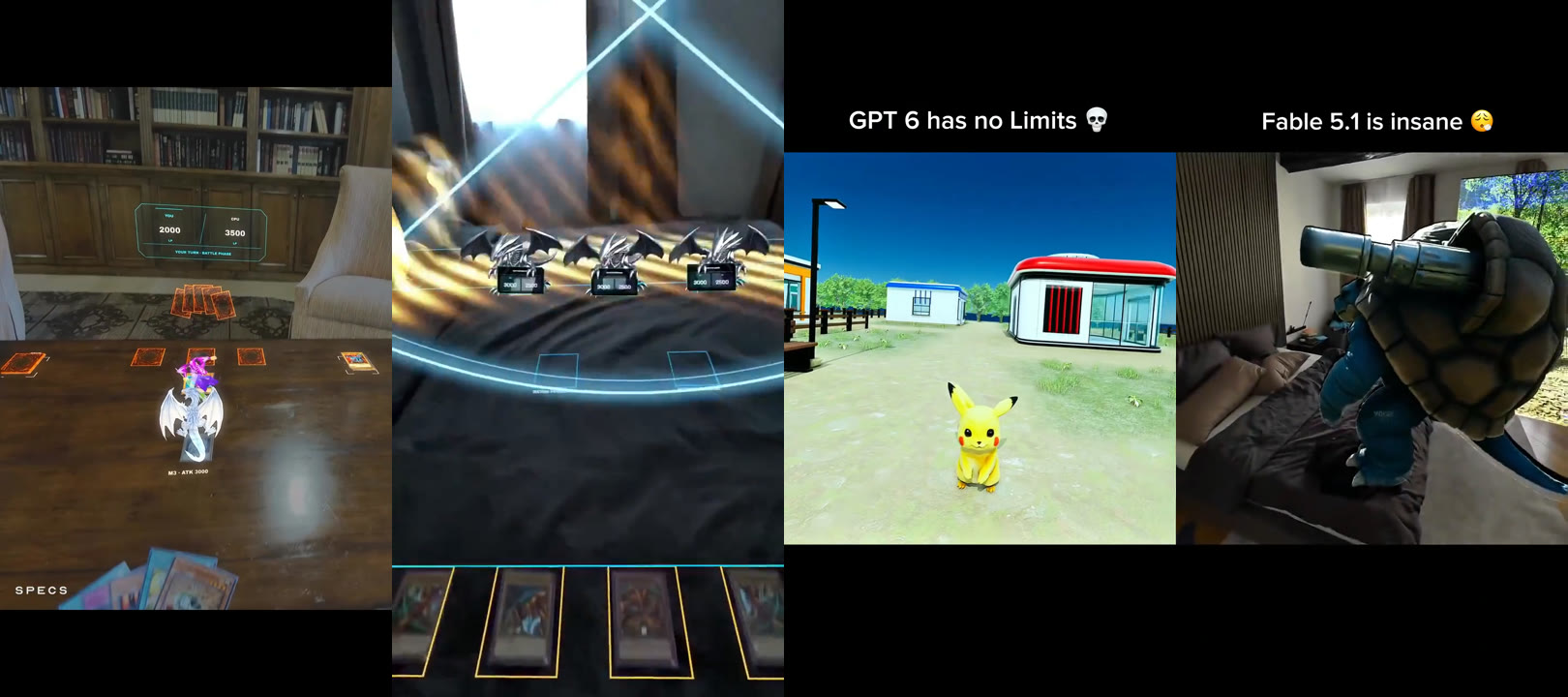
TL;DR — A Korean FMKorea post stitching together six AI-and-AR clips — Yu-Gi-Oh monsters on a coffee table, a Blastoise walking out of a portal onto a bed — passed 149,000 views within about eight hours on 2026-09-24. Only one of the six traces to a named builder: the Yu-Gi-Oh duel on Snap’s Specs glasses, credited to “shinbuilder” and spread a day earlier by the Japanese card shop GRIM SHOP, where it drew 4.69 million impressions. It is a fan prototype, not a Snap or Konami product. And the “CLAD” that the viral post called a tracking technology is really Snap’s own AI build pipeline for Specs — closed loop agentic development, which lets Claude Code, Codex or Cursor build lenses in Lens Studio. The other five clips name AI models in their captions but not their makers, and a caption is not a credit.
Where the clips came from

FMKorea, posted 2026-09-24 14:21 KST. 147,321 views when I captured it; 149,293 about eight hours after posting.
The post is a compilation: six vertical clips, no credits, and one line at the bottom listing what the videos mention — Snap’s Specs AR glasses, Meta Quest, GPT-6 Astra and Claude.
The best-known clip had already gone viral the day before. On 2026-09-23 GRIM SHOP posted it on X, crediting shinbuilder, as an AR Yu-Gi-Oh you can really duel with using physical cards — built for Specs, it said, by combining an AI technology called “Astra” with a tracking technology called “CLAD”. [GRIM SHOP on X] Hashout counted 4.69 million impressions, 28,000 likes, 7,341 bookmarks and 5,039 reposts, and checked the obvious question: this was not an official announcement by Snap or by Yu-Gi-Oh’s rights holder. [Hashout] BlockTempo found the builder’s X profile: 92 followers and a bio that reads “Build build build”. [BlockTempo]
The six clips at a glance
| # | Caption in the clip | What it shows | Hardware you can see | Maker traced |
|---|---|---|---|---|
| 1 | — | Yu-Gi-Oh duel with physical cards; life points against a CPU | Snap Specs (“SPECS” mark on the capture) | shinbuilder, via GRIM SHOP |
| 2 | “Did I go too far this time?” | Blue-Eyes White Dragons, then Exodia, on a bed-sized duel field | not identifiable | no |
| 3 | “GPT 6 has no Limits 💀” | a Game Boy-style town map turning into a walkable 3D town, with a Pikachu | not identifiable | no |
| 4 | “Fable 5.1 is insane 😮” | a forest portal in a bedroom; a Blastoise walks through onto the bed | a handheld controller | no |
| 5 | “Using AI for this feels worth it ngl” | a door-shaped portal into a neon city | a handheld controller | no |
| 6 | — | Pokémon TCG battle with physical cards, HP bars, “PIKACHU USED CHARGE!” | not stated | no |
Clip 1: the Yu-Gi-Oh duel on Specs — real, and unofficial
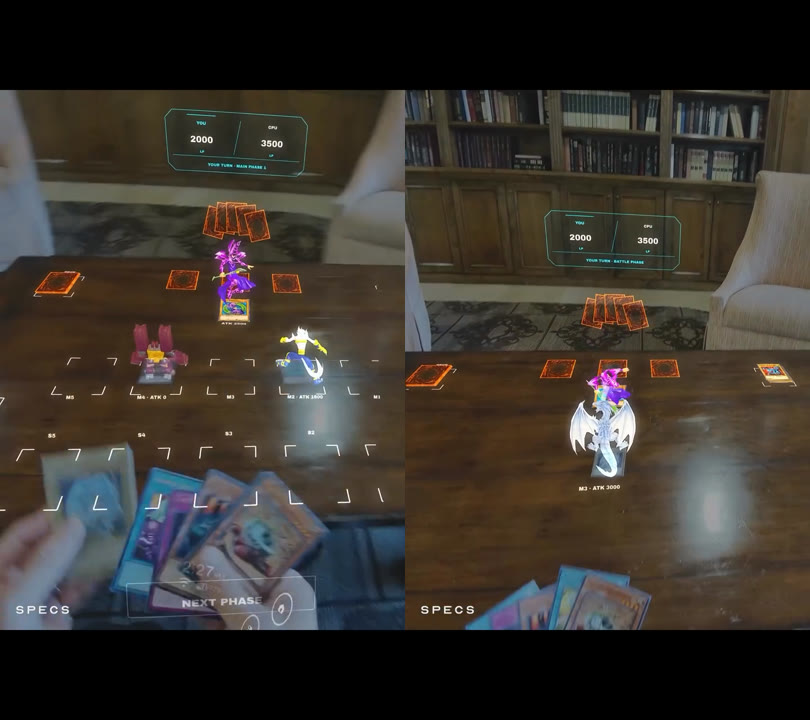
Frames from clip 1, as reposted in the FMKorea compilation.
What you can read straight off the frames:
- It is a duel against the computer. The floating scoreboard reads YOU 2000 / CPU 3500, with the phase underneath (“Main Phase 1”, then “Battle Phase”). The opponent’s cards are virtual; yours are real ones in your hand.
- The field knows the rules. Monster zones are labelled with attack values — “M3 · ATK 3000” under the Blue-Eyes — and there is a NEXT PHASE button.
- It was recorded on Specs. The “SPECS” mark sits in the corner of the capture.
So “duel for real with physical cards” is half right. The cards are physical; the opponent is not a person.
That half is still the interesting part. A 3D Blue-Eyes is the easy bit. The hard bit is the game state — whose turn it is, which phase, who has how many life points — plus knowing which card you just played. The clip shows the first working. How the glasses identify each card isn’t explained anywhere I could find.
It also wasn’t made on a store-bought pair. Snap announced consumer Specs at $2,195 on 2026-06-16, with preorders on a $200 refundable deposit and shipping “this fall” in the US, UK and France. [TechCrunch] At the 2026-09-16 launch event in Los Angeles, Snap still gave no ship date; public demos in Los Angeles start on 1 October. [AR Insider]
Fans have wanted this for years. In 2021 a Reddit user posted a phone-based “Smart Duel Disk” prototype on r/yugioh. [ComicBook.com] Five years later the difference is who writes the code.
What “Astra” and “CLAD” actually are
GRIM SHOP called CLAD a tracking technology, and Hashout could not confirm either name as official Snap technology. CLAD is official. It just isn’t tracking.
Snap’s Specs developer documentation defines CLAD as closed loop agentic development: a suite of agents and skills that let AI build in Lens Studio, optimised for Specs. It names Claude Code, Codex and Cursor as the assistants it works with, and its example prompts are things like “Build a Periodic Table experience for SPECS” and “Add tests to my Lens”. [Specs docs: CLAD]
The setup is an MCP connection. You open Lens Studio first, it exposes a server, and the coding agent connects to it from the project folder; the setup guide warns that a full Lens build can take more than 30 minutes. [Specs docs: Claude Code setup] Snap’s Lens Studio documentation describes the same server letting an agent create objects, change components, search the asset library, write scripts and debug. [Snap for Developers]
Read that way, “Astra + CLAD” is not two technologies inside the glasses. It is the build process: GPT-6 Astra, OpenAI’s model released on 2026-09-03 and usable through Codex, driving Snap’s own agent pipeline. [Wikipedia] [Terapep: Astra in Codex] That is my reading of the credit, not something the builder has explained.
Clips 2–6: captions are not credits
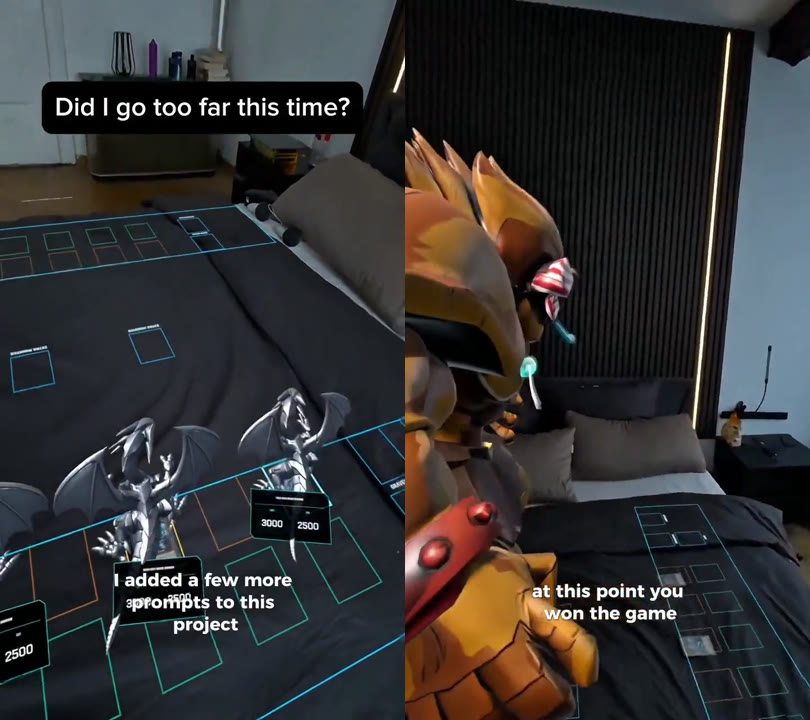
Clip 2. Other captions in the clip: “I added a few more prompts to this project”, “at this point you won the game”.
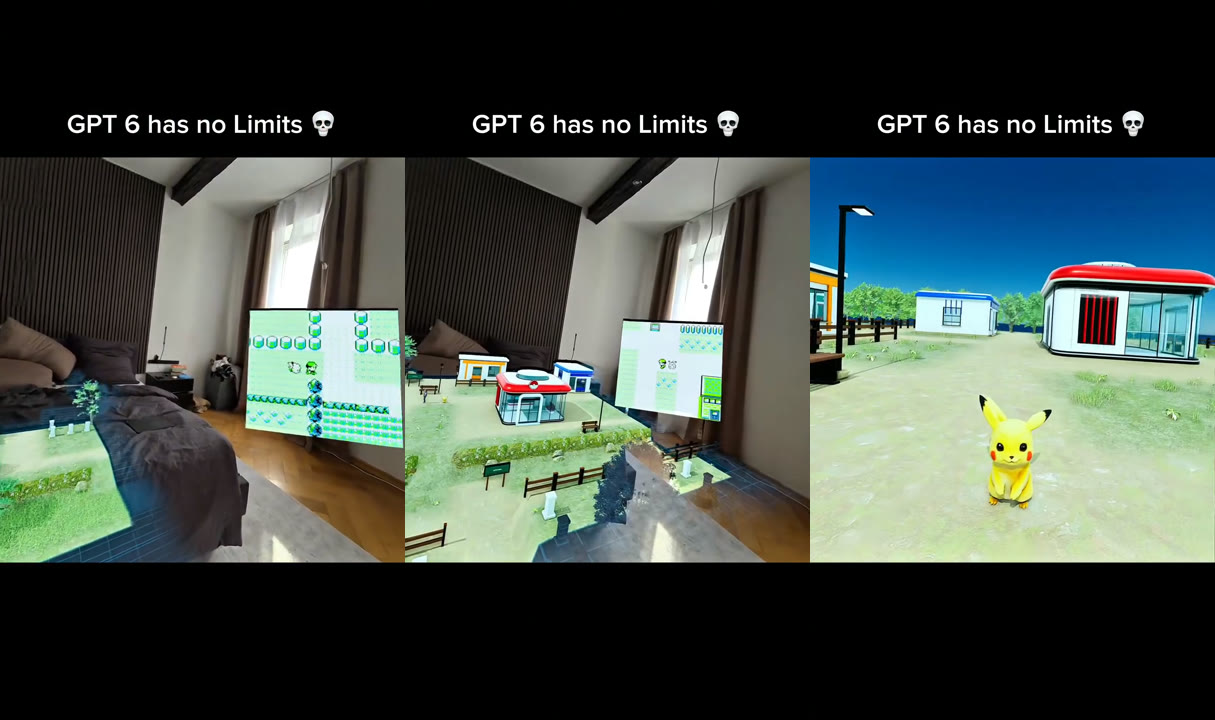
Clip 3, captioned “GPT 6 has no Limits 💀”.
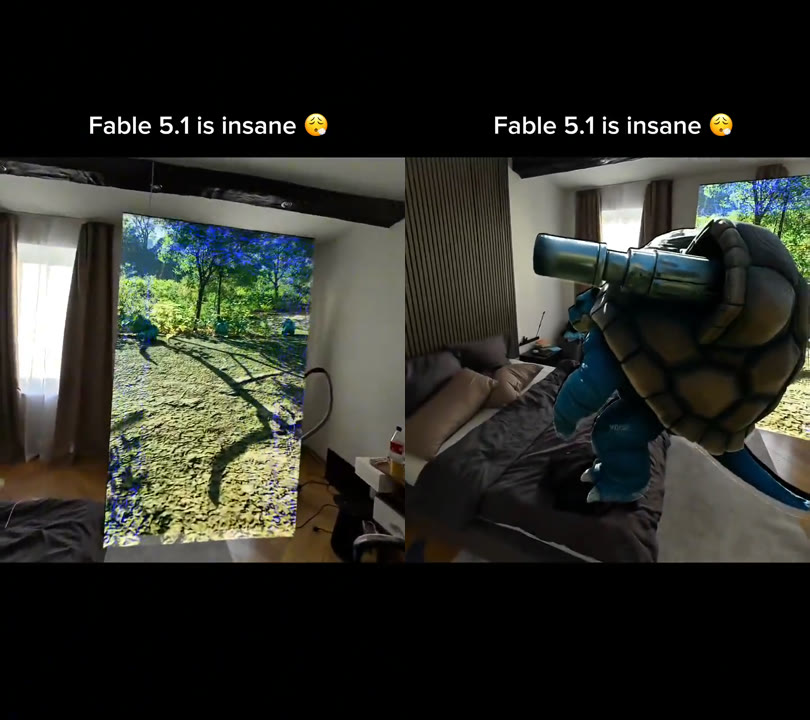
Clip 4, captioned “Fable 5.1 is insane 😮”.
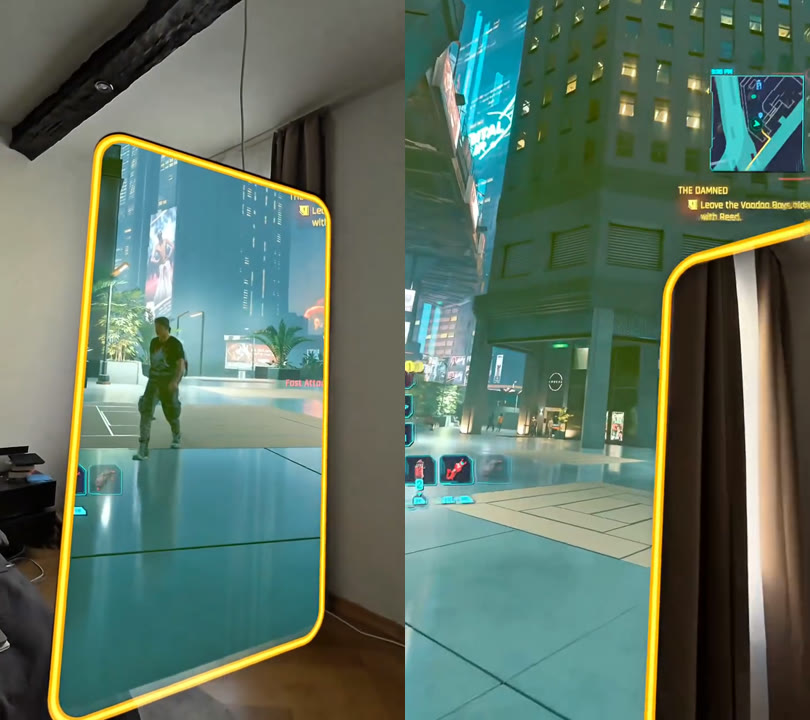
Clip 5, captioned “Using AI for this feels worth it ngl”.
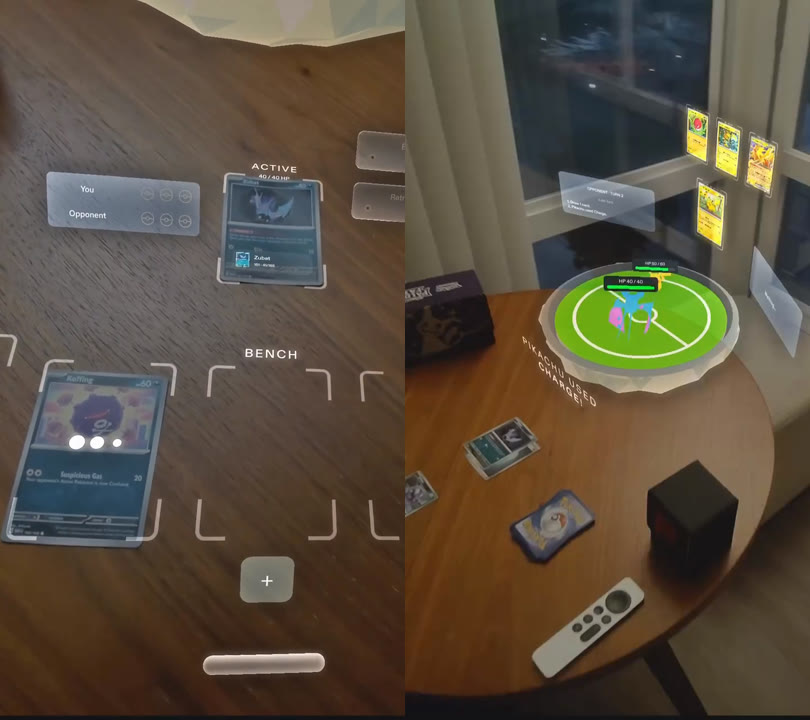
Clip 6, no caption.
What these can and can’t tell you:
- The model names are real; the credits aren’t there. “GPT 6” and “Fable 5.1” point at two models less than a month old — OpenAI’s GPT-6 Astra (2026-09-03) and Anthropic’s Claude Fable 5.1 (2026-09-01). [Anthropic] [MacRumors] Neither clip says what the model did: wrote the app, made the 3D, or just the caption.
- Clip 5 appears to contain real game footage. Inside the portal is a quest tracker reading “The Damned — Leave the Voodoo Boys hideout with Reed”, with a minimap in the same style. Those are Cyberpunk 2077 names. If an AI built anything there, it was most likely the portal, not the city.
- Clip 3 is the most ambitious of the set. A 2D map becoming a lit 3D town you can walk into beside a Pikachu is a lot to credit to one caption. It may be exactly what it looks like, or several tools and an editor. Without a maker, there is no one to ask.
- Clip 2 hints at the workflow. “I added a few more prompts to this project” describes iteration, not a single magic prompt. That matches how CLAD itself is pitched: a closed loop of design, build and test.
I searched for the originals of clips 2–6 by their captions and scenes and found none. If you know who made them, I’ll add the credit.
What Korean commenters said
The 92 comments under the FMKorea post split three ways (paraphrased):
- Awe and jokes. “Has the singularity arrived?”, and a warning that game-style status windows are next — a nod to Korean web-novel fantasy, where heroes see their stats floating in the air.
- Practical doubts. Fast shooters in a headset still run into motion sickness. VR shooters already exist and never found a big audience. One commenter who bought Meta’s latest headset at launch wasn’t impressed.
- Rules pedantry. How do you summon a Blue-Eyes without two tributes? Someone pointed out that two monsters go to the graveyard later in the clip.
Can you build one?
- Specs: preorder at $2,195 with a $200 deposit; no ship date as of 2026-09-24. You build in Lens Studio, and CLAD lets Claude Code, Codex or Cursor do the building.
- Quest: the compilation lists Meta Quest, but none of the other clips names its hardware or tools.
- The characters: Yu-Gi-Oh belongs to Konami and Pokémon to The Pokémon Company. BlockTempo noted that a commercial version of the duel would need Konami’s licence. [BlockTempo] Fan demos can go viral; turning one into a product is a licensing question, not a coding one.
For the wider pattern — what people actually build with Astra, and which of it survives being opened — see What People Actually Built With GPT-6 Astra and Inside Korea’s AI Game Boards.
FAQ
Is the AR Yu-Gi-Oh duel an official Snap or Konami product? No. Hashout confirmed it was not announced by Snap or by Yu-Gi-Oh’s rights holder. It is a fan prototype credited to shinbuilder.
What is CLAD? Closed loop agentic development — Snap’s suite of agents and skills that let AI assistants such as Claude Code, Codex and Cursor build Specs lenses in Lens Studio. It is a build tool, not a tracking technology.
Was the duel made with GPT-6 Astra? The credit says “Astra”. The most plausible reading is OpenAI’s GPT-6 Astra, via Codex, driving CLAD. The builder hasn’t said.
Is it a two-player game? Not in the clip. The scoreboard reads YOU against CPU.
Can I buy Specs? You can preorder them at $2,195 with a $200 refundable deposit. Shipping is listed for fall 2026 in the US, UK and France, with no date as of 2026-09-24.
Are the Pokémon clips real? Unknown. None names its maker, and clip 5’s portal shows what looks like Cyberpunk 2077 gameplay.
Sources: FMKorea, GRIM SHOP on X, Hashout, BlockTempo, Specs docs: CLAD, Specs docs: Claude Code setup, Snap for Developers, TechCrunch, AR Insider, ComicBook.com, Wikipedia: GPT-6 Astra, Anthropic, MacRumors.
Images: frames from the clips as reposted in the FMKorea compilation, and a crop of the post header. Clips 2–6 are uncredited in the compilation; the makers could not be traced.
← Back to all posts