GPT-6 Astra Libraries on GitHub: The Dozen That Are Real, and Why They Exist
GitHub’s gpt-6-astra topic holds 58 repositories and most are not libraries. The ten that are, what each does, and the API-shape constraint that explains why an adapter category exists at all. Stats read from the GitHub API on 13 September 2026.
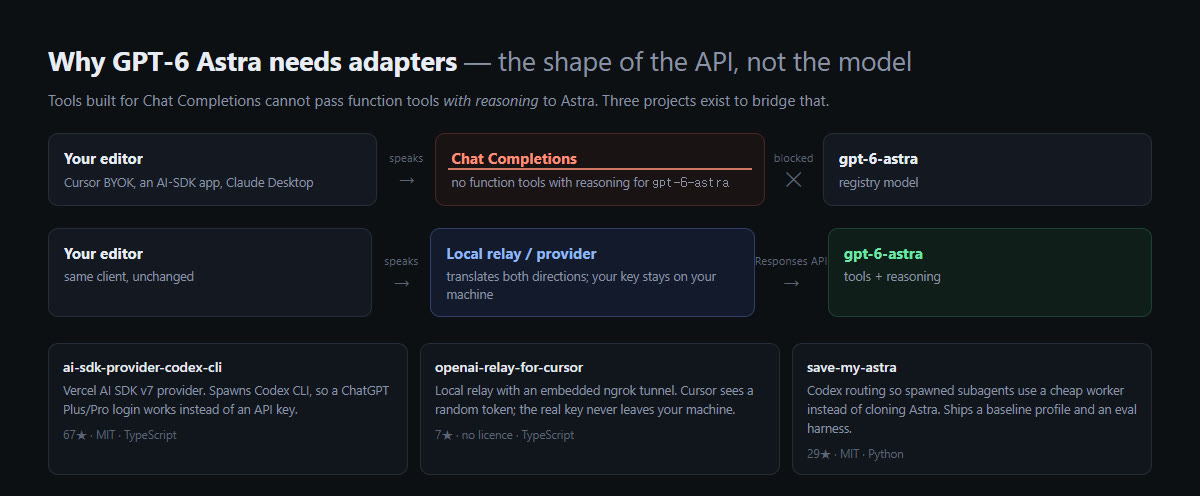
TL;DR — GitHub's
gpt-6-astratopic holds 58 repositories, and most are not libraries. Stripped of curated lists, demos and account-resale ads, about a dozen are real tooling — and the largest single category is not "build things with Astra" but "spend less on Astra". The reason any of it exists is narrower than the hype: Astra needs the Responses API for function tools with reasoning, and most editors speak Chat Completions. Everything below was checked against the GitHub API on 13 September 2026.
First, why there is tooling at all
The interesting constraint is not the model. It is the API shape.
The clearest statement of it is in the README of openai-relay-for-cursor:
Cursor's "bring your own key" (BYOK) path talks Chat Completions to a custom base URL, and Cursor's backend refuses to route registry models such as
gpt-6-astraover it. OpenAI in turn only supports function tools with reasoning for Astra via the Responses API.
So an editor that speaks Chat Completions cannot give Astra tools and reasoning at the same time — which is the whole point of using it as a coding agent. That single mismatch is why an adapter category exists, and it explains why the tooling clusters into two shapes: things that translate the protocol, and things that avoid paying for it.
The libraries that are actually libraries
| Repository | What it is | ★ | Licence | Language |
|---|---|---|---|---|
| ai-sdk-provider-codex-cli | Vercel AI SDK v7 provider that drives Codex CLI | 67 | MIT | TypeScript |
| save-my-astra | Codex routing so subagents use a cheap worker | 29 | MIT | Python |
| atelier | Headless pixel-art editor an agent can drive over MCP | 7 | MIT | Rust |
| codex_oracle | Codex plugin for Astra/Pro reviews via ChatGPT Web | 7 | MIT | Go |
| openai-relay-for-cursor | Chat Completions → Responses API relay for Cursor | 7 | none | TypeScript |
| mechapad-cli | Run Astra, Fable 5.1, DeepSeek and Gemini in parallel | 2 | MIT | TypeScript |
| frontier-simplify | Skills to cut invented process and repeat reviews | 2 | MIT | Python |
| Fusion-Native-MCP | Fusion 360 skills and MCP server for Astra | 1 | MIT | Python |
| claude-gpt | MCP letting Claude Desktop delegate to Astra | 0 | MIT | Python |
| premium-model-budget-governor | Workflow budgets, approvals and usage receipts | 0 | — | Python |
Star counts are small because the model is ten days old. Judge these on what they do, not on their score.
ai-sdk-provider-codex-cli — the most finished thing here
The only project in this space that looks like a maintained package rather than a weekend fix. It is a Vercel AI SDK v7 community provider that works by spawning Codex CLI, which means it authenticates with a ChatGPT Plus/Pro login rather than an API key — codex login writes ~/.codex/auth.json and the provider uses it.
Two modes, and the difference matters:
codexExec— spawns a freshcodex execprocess per call. Simple, stateless, fine for CI.codexAppServer— a persistentcodex app-serverJSON-RPC client. One shared process, true delta streaming, optional stateful threads.
It works with generateText, streamText and generateObject, is ESM-only, needs Node ≥ 22, and maintains separate release lines for AI SDK v4 through v7 with branch and npm tags for each. It predates Astra — created August 2025 — which is why it is the mature one.
The catch: it spawns a local process, so it is Node-only and not something you deploy to an edge runtime.
openai-relay-for-cursor — the protocol translator
Small, single-purpose, and it solves the exact problem in the diagram. It sits between Cursor and OpenAI, translating in both directions, with an embedded ngrok tunnel so one pnpm start gives you a public HTTPS endpoint.
The design detail worth copying: your OpenAI key never leaves your machine. Cursor is handed a random relay token instead. If you were going to hack something similar together yourself, that is the part to keep.
It has no licence file, which means no grant of rights — read it, learn from it, and be careful about shipping it into anything commercial.
save-my-astra — the one with intellectual honesty
A Codex routing configuration whose premise is that Astra should orchestrate and something cheaper should do the legwork. Without routing you get Astra → Astra → Astra; with it, an Astra parent spawning cheap workers.
Four profiles, installed by a script that backs up your existing config.toml and AGENTS.md to ~/.codex/backups/ first and does not touch model_provider, MCP servers, notify paths or plugins:
| Profile | Parent | Child |
|---|---|---|
astra-luna (default) |
gpt-6-astra / low |
gpt-5.6-luna / max |
astra-terra |
gpt-6-astra / low |
gpt-5.6-terra / max |
astra-solo |
gpt-6-astra / low |
off — baseline |
sol-luna |
gpt-5.6-sol / low |
gpt-5.6-luna / max |
Note the parent runs at low and the child at max. That inverts the intuition that the orchestrator should be the smart one, and the README does not oversell it:
This is a hypothesis to install and measure, not a claim that the pairing is cheapest.
It ships an astra-solo baseline profile to measure against, an eval/ harness, and a docs/method.md setting out what counts as a supportable claim. A 29-star repository shipping a control condition and rules for its own conclusions is rarer than it should be.
Its sharpest observation is a billing one:
Plus quota is not API spend. Subagent runs can use more tokens and still cost less if cheap tokens replace expensive ones.
claude-gpt — cross-vendor delegation
An MCP server for Claude Desktop that hands heavy work to Astra and relays the answer back into the same chat: persistent sessions, real file attachments, background jobs that survive restarts, a dashboard, cost tracking. On PyPI, MIT, CI badge, macOS-only, Python 3.12+.
Zero stars as of today, which says nothing about the code. The pattern — one vendor's assistant orchestrating another's model — is the most interesting idea in this list and almost certainly not the last implementation of it.
What the shape of this ecosystem tells you
Three of roughly a dozen tools exist to spend less. save-my-astra routes work to cheaper models, premium-model-budget-governor adds budgets and usage receipts, and mechapad-cli runs several models in parallel so you can pick. On a ten-day-old model, cost control arriving before capability tooling is a signal about what using it in anger feels like.
That matches what Korean game-makers report independently: the Astra Attack creator's stated development limit is "as far as time, money, and the Astra usage cap will stretch."
The adapters are about protocol, not capability. Nobody is writing a library to make Astra better at something. They are writing libraries to get existing tools to talk to it.
Almost everything is MIT and days old. Of the ten above, eight are MIT, one has no licence, one is unspecified. Median creation date is early September. Expect breakage.
What to skip
Being specific is more useful than a warning label.
Account and credit resale. The topic's second-largest repo by stars is a Chinese enterprise ChatGPT Plus/Pro/Team procurement platform, and another guide promises "FREE GPT-6 Astra via AgentRouter — OG credits, one API key." Reselling access is against OpenAI's terms, the credits evaporate, and you are handing your prompts to an intermediary. If the pitch is free frontier access, you are not the customer.
Jailbreak toolkits. At least one repo in the topic is an instruction-configuration kit whose Chinese description translates as "full armour-breaking," framed for penetration testing. Whatever you think of that use case, it is not a library for building things, and it is in the topic because topics are self-assigned.
Name collisions. nimelkot/astra is a code-intelligence tool with AST graphs and an MCP server — created 22 August, before GPT-6 Astra existed. Searching by product name pulls in unrelated projects. Filter by creation date.
Curated lists presented as tooling. Several of the highest-starred entries in the topic are prompt collections and demo galleries. Useful, but they are reading material, not dependencies.
How to read the topic honestly
topic:gpt-6-astra returns 58 repositories. A topic is a label the author applies to their own repository — nobody reviews it. Inclusion means someone typed the word.
A rough breakdown of what those 58 actually are: curated prompt and demo lists, individual games and demos, resale or proxy services, and — the smallest group — libraries you would add to a project. Sort by stars and you mostly get the lists, because lists are easy to star and dependencies are not.
If you want the tooling, sort by recently pushed and read descriptions, or start from the ten in the table above.
What this article does not establish
I have not run any of these. Every claim about behaviour comes from the project's own README or its GitHub metadata. What I verified is that the repositories exist, their stated licence and language, their creation and last-push dates, and their star counts on 13 September 2026.
Star counts are a bad proxy this early. A ten-day-old ecosystem has not sorted itself. claude-gpt has zero stars and is on PyPI with CI; several higher-starred entries are link collections.
The API constraint is quoted, not tested. The statement that Astra supports function tools with reasoning only via the Responses API comes from the relay's README and is consistent with why the relay exists, but I did not reproduce it against the API myself.
The category breakdown of the 58 is my reading, not a labelled dataset. Someone else sorting them would draw the lines slightly differently.
FAQ
What libraries exist for GPT-6 Astra?
About a dozen, most created in early September 2026. The substantial ones are ai-sdk-provider-codex-cli (Vercel AI SDK v7 provider, 67★), save-my-astra (subagent cost routing, 29★), openai-relay-for-cursor (Chat Completions → Responses API relay), and claude-gpt (MCP delegation from Claude Desktop). GitHub's gpt-6-astra topic has 58 repositories but most are prompt lists and demos.
Why can't I just use Astra in Cursor with my own API key?
Cursor's BYOK path speaks Chat Completions, its backend declines to route registry models such as gpt-6-astra over it, and OpenAI supports function tools with reasoning for Astra only through the Responses API. A local relay that translates between the two is the current workaround.
How do people reduce GPT-6 Astra costs?
By routing. save-my-astra configures Codex so an Astra parent spawns cheaper workers rather than cloning itself, and ships a baseline profile plus an eval harness so you can measure whether it helps. Its own README declines to claim the default pairing is cheapest. Separately, premium-model-budget-governor adds explicit budgets and usage receipts.
Can I use Astra with a ChatGPT subscription instead of an API key?
ai-sdk-provider-codex-cli works this way: it spawns Codex CLI, which authenticates with your codex login credentials from ~/.codex/auth.json. It is Node-only because it spawns a local process, so it will not run on an edge runtime.
Are the "free GPT-6 Astra" repositories safe?
No. Several repos in the topic advertise free frontier access through credit routers or resold accounts. That breaches OpenAI's terms, the access disappears without notice, and every prompt you send goes through an intermediary you have no agreement with. Use your own key or your own subscription.
← Back to all posts